Red, White, & Sometimes Blue (Pt. 1)
State Senator Nick Collins campaigns as a Democrat. Yet, his no votes on police accountability, immigrant driver's licenses, and Michelle Wu's tax shift tell a different story. And homeowners bear the brunt of those decisions.
Don't have time for the full article? Listen to the episode on Spotify.
In the spring of 2013, in a district that ran from the triple-deckers of South Boston down through Dorchester into Mattapan and the edge of Hyde Park, roughly 21,700 people voted in a Democratic primary and ended a dynasty by a few hundred ballots. Linda Dorcena Forry, the daughter of Haitian immigrants, beat South Boston state Representative Nick Collins and took a seat once held by William Bulger for twenty-five years, then Stephen Lynch, then Jack Hart.
Collins did not lose because South Boston abandoned him. He lost because the rest of the district finally outvoted it.
He has never had to face that arithmetic again.
Forry left for the private sector in 2018 and endorsed her old rival at his campaign kickoff, a courtesy extended by a colleague on her way out the door in a city where such courtesies are currency. No other Democrat filed. Three years later, the ground itself was rearranged. The 2021 redistricting traded Dorchester precincts for more of South Boston and the waterfront. In a single step, the district's Black share fell from roughly 36 percent to 21 while its white share climbed from 34 to 46 and its median household income crossed six figures. Voting rights advocates warned lawmakers at the time that the map was pulling voters of color out of a Boston Senate seat and leaving a white bloc decisive. The map passed anyway.
Collins did not draw those lines. He has simply never stopped standing on them.
And when Boston tried to move power the other way, he turned up to help stop it. In 2022, the City Council approved a municipal map moving several predominantly white precincts out of District 3 and into District 4, which centers on Mattapan, and moving minority precincts the other way. A lawsuit followed, funded in part by two sitting councilors (Frank Baker and Ed Flynn) at $10,000 each, on the theory that race had wrongly predominated the decision. Among those the Bay State Banner reported were lined up to testify against the map: Congressman Stephen Lynch, Councilors Ed Flynn and Michael Flaherty, former city clerk Maureen Feeney, and the sitting senator from the First Suffolk. In May 2023, a judge granted a preliminary injunction on Fourteenth Amendment grounds and barred the city from using the map.
Lay the voting record over that geography and the pattern stops looking accidental.
At four in the morning on July 14, 2020, the Senate passed its police accountability bill 30 to 7. Collins voted no, one of five Democrats standing with two Republicans. Representative Russell Holmes, then chair of the Black and Latino Legislative Caucus, whose Dorchester and Mattapan constituents were also Collins's constituents, said he was surprised. Makes sense when you consider that at the time, Collins was representing what was then one of only three majority-minority Senate districts in Massachusetts. In 2022, when the Senate voted to let residents obtain driver's licenses regardless of immigration status, Collins voted no, one of five Democrats alongside three Republicans. In 2025, he voted for an amendment barring families from emergency shelter unless they had lived in Massachusetts a year. Six senators supported it. Five were Republicans. That May he was one of four Democrats who crossed party lines to block the state's transition to zero-emission vehicles.
Then came the vote that decided something.
When collapsing office valuations threatened to push more of Boston's tax levy onto homeowners, Mayor Michelle Wu asked the Legislature for temporary authority to shift part of it back toward commercial property. Collins tabled the petition three times in 2024 and helped bury it in 2026, when the Senate rejected it 33 to 5. Four of the six senators representing Boston voted yes. Collins was one of the two who did not. Homeowners absorbed an average 13 percent tax increase, roughly $780 on a single-family house. Wu has said Boston homeowners would have kept more than $150 million over two years had the Senate let it through, and that South Boston residents alone would have saved $8 million last year. After stymying efforts in a non-election year, Collins then offered his own remedy in 2026: exemptions, credits, and permission for the city to spend its own surplus on rebates. In other words, he let the bill land for everyone, then proposed public money to soften it for a chosen few.
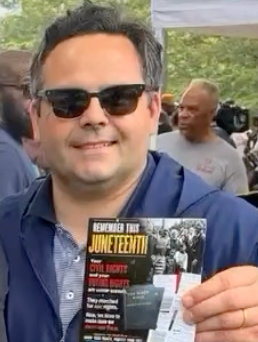
Collins attends Juneteenth and other Black cultural events. He posts the photographs. He circulates the endorsements of Black elected officials. The currency of those endorsements is the implication that he can be trusted with the interests of the people who elected them. It is worth asking what exactly that trust is purchasing.
The city's own Assessment of Fair Housing found that 44 percent of white households in Boston own their homes against 30 percent of Black households. The gap is not closing on its own: in 2023, Black households received 9.4 percent of mortgages for one-to-four-unit homes in Boston while white households received 65 percent. Property taxes are the mechanism by which a city decides who carries the cost of owning something. Tilt the levy toward residential property and the burden falls on a class Black Boston was systematically kept out of and is struggling to hold onto. Preserve the commercial cut and the benefit accrues to a class it was never in.
Closing a wealth gap that was built deliberately requires deliberate action in the other direction. What the First Suffolk got instead was intentionality pointed the same way it has always been pointed. The Black History Month photographs are free. The tax vote cost his Black constituents money, and it was a choice, made on a recorded roll call, in a chamber where four of his six Boston colleagues chose otherwise.
The rest of the operation matches.
Based on images being widely circulated on social media, Collins chief of staff, Haley Walsh, appears to have attended the 2024 Republican National Convention in Trump-branded attire. A chief of staff advises on which bills get filed, which amendments get backed, which constituents get a call returned, and how a senator's budget priorities are written. So: did Collins know before he handed the most powerful staff job in his office over that her politics may align with an ideology that threatens the lives and livelihoods of his own constituents? Does he consider attendance at the convention that nominated Donald Trump and other now-deleted social media posts disqualifying, irrelevant, or an asset? And in a district where more than a fifth of residents are Black and immigrant families who are under siege by the policies and personnel of the Trump administration, whose interests does he believe are being represented in the room where his legislative agenda is set?
Then there is Mass Daily News, whose editorial pattern the Ledger documented in RIGGED. It has told readers that rising taxes were "not Nick Collins'" fault, accused his challenger of being a "far-left activist," and counted her pronouns on Instagram as evidence. A politician does not get adopted by this publication like that passively. In fact, based on our analysis, it only seems to choose one type of politician who embraces one type of worldview. He either welcomes it or repudiates it. Collins has done neither, and the questions follow: has his office or campaign supplied information to Mass Daily, and does he endorse the way it has characterized a Black woman running against him? Silence is an answer. We suspect it is not the one he would give at the Martin Luther King annual breakfast.
Thirteen years ago this district looked at Nick Collins and said "no." He never won those voters back. He never had to. The precincts that beat him were moved, the coalition thinned, and he has governed ever since as though it no longer exists.
Someone is still paying for the lawn signs going up on streets where the tax bills went up too. South Boston, the neighborhood that is his entire identity, supplies roughly a dime of every dollar he raises. Commercial real estate supplies twice that.
Part 2 follows the money. Stay tuned.
"Red, White & Sometimes Blue" examines New England Democratic politicians whose governing records reveal a more complicated ideology than their party label suggests: lawmakers who campaign on Democratic values but often side with Republicans, business interests, or traditional power structures on issues affecting their working-class constituents.